
Meredith Perkins and Ally Britton-Heitz
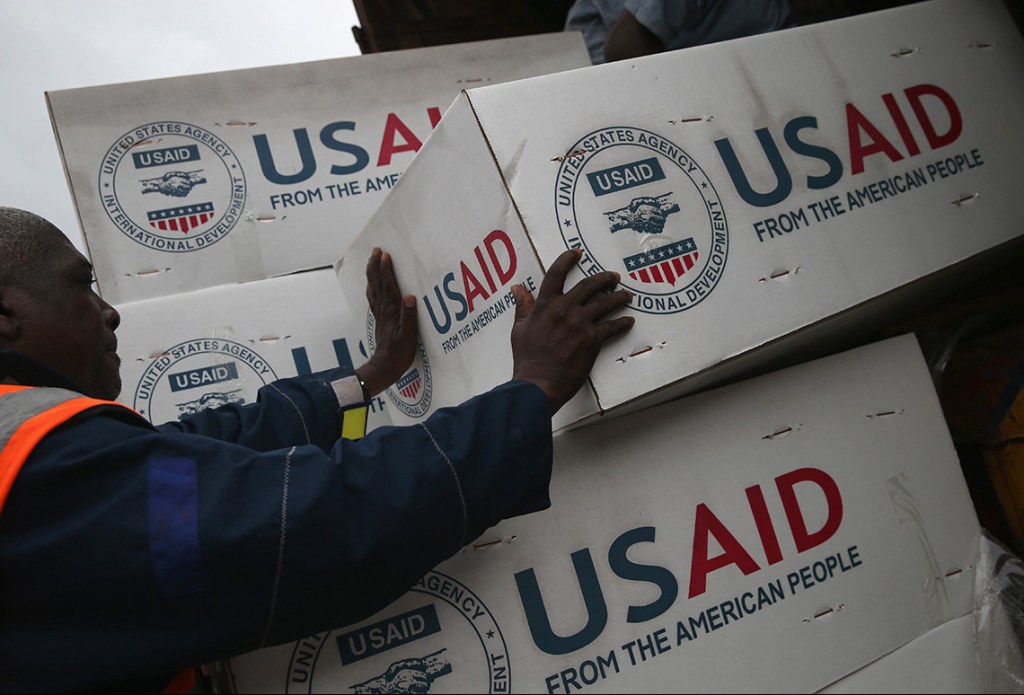
On Feb 12, Shannon Maguire, senior media adviser of USAID’s Europe and Eurasia Bureau, visited Miami University to give a talk on media censorship and global challenges related to media. As an employee of USAID, or the United States Agency for International Development, Maguire oversees regional media development programs and assists journalists who may be struggling with challenges in the independent media sector.
Prior to her speech, Maguire met with Ally Britton-Heitz, Joe Byrnes, and Meredith Perkins of the Miami Political Review for Bodega sandwiches and a conversation on international development, challenges to journalists, careers in journalism, and more.
Note: These views are Ms. Maguire’s own views and do not necessarily represent the official views of USAID or the U.S. government. Responses have been edited for length and clarity.
M. Perkins: What made you interested in international development? What was your path to working at USAID?
S. Maguire: In college [at Mary Washington University], I majored in political science. For my last two years, I started taking international affairs classes. I did a bunch of volunteer work, and Mary Washington had a lot of graduates who went to the Peace Corps. We had people who would come from the Peace Corps and talk about their experiences: living and working overseas, but working on different challenges and community issues. So I decided to apply, and I was a Peace Corps volunteer in Uzbekistan. That’s where I really fell in love with development work. I was there for about 1.5 years, and I was immersed in Uzbek.
When I applied to grad school [at Georgetown], Uzbek is really similar to Turkish, so I got offered a fellowship in Turkish. The fellowship was going to pay the bills, but the focus of the program was Russian and Eastern European studies, so I had to do a Russian language bootcamp. I did an eight week language crash course, along with Turkish. It was very crazy. I ended up graduating with three languages under my belt.
Long story short, I was sort of just drawn to this career in international development. We were posted where [my husband] was posted [with the Foreign Service], but the deal was as long as we were posted in countries I could find development work (NGO work) we could do this. He went to Iraq, and I went back to Washington and found a job working on democracy issues with a donor organization. Then we went to Bosnia and Rwanda. In each of these places, I ended up working for USAID as a contractor, not as a permanent civil servant.
After Rwanda, he had been in the foreign service for 13 years. It was really exciting, but it felt like I was reinventing my job every year. So, we came back to Washington. Then, I found a position in the Europe-Eurasia bureau, which allowed me to come back to what I had studied in college and in grad school.
It’s funny, because I wasn’t a journalist. I didn’t go to journalism school, I never worked as a journalist. But through these different jobs I had ended up in this new field focusing on media development, a new sub sector of democracy governance work developed in the 90s when the Soviet Union collapsed. I started around 2007.
M. Perkins: What is one of the programs you manage as a senior media adviser?
S. Maguire: I manage the STAIR (Strengthening and Accountability through Investigative Reporting) program. Investigative journalists are like the “special forces of journalism.” They go after the tougher targets; they are usually more vulnerable to threats, harassment, and security issues, and their reporting tends to have higher impact. Journalists in particular that we work with — it’s pretty amazing — go after organized crime and high-level corruption. They are following the money train, and it leads to oligarchs, the mafia, paramilitary groups sometimes, crooked police, and some high-power political and financial elites, so the folks we’re working with are pretty amazing. It’s probably my favorite program.
We work largely with a group called the Organized Crime and Corruption Reporting Project: OCCPR: a network of investigative journalists, local investigative journalists, from Europe and Eurasia, that are working in, on, the region. Some of them focus on stories just in their country, but for the most part, a lot of what the OCCPR network and members do is like cross-border, collaborative reporting.
The way [STAIR] evolved over the years was focusing on building reporting teams and building the tools so that they can do their work,creating different platforms to connect the teams’ databases, Further, then also how to refine the data, how to create stories from the data, visualize the data for audiences, and to explain these complicated topics for an audience who isn’t familiar with crime and corruption.
Building on efforts over the years, our new program will focus on OCCRP, but we also want to grow the next generation of investigative reporters and get outside of the capitals. Unfortunately, all of the outlets we work with are based in capital cities because of resources, but we want to reach out to smaller cities, work with younger investigative journalists. It’s a lot of investment and resources we need to grow and diversify the next generation. It depends on the country what diversity and representation will look like too.
With STAIR, we really want to take an intentional approach to safety and security. We used to look at safety and security for journalists mostly as physical security (protecting from harassment, threats, etc.), and while we still focus on physical security — what to do if you’re being surveilled, how do you physically protect your office and store your information — but it’s also digital safety, digital security, legal safety, and psycho-social security.
M. Perkins: What do you think are some of the biggest challenges facing journalists and free speech in Europe — and particularly Eastern Europe — today?
S. Maguire: I look at the challenges as four types of censorship, and this is specific to all types of journalism: hard censorship, soft censorship, noisy censorship, and digital capture.
Hard censorship is classic “kill journalists, jail journalists, passing really restrictive laws on what journalists can say” — very straightforward.
Soft censorship is a lot harder to detect. It can be what we call financial capture, where oligarchs — who are private actors, but own most of the mainstream media (i.e. Vanity Press) — have what we call a vanity press. They dictate the editorial policy: what journalists can and can’t write about, and, again, these oligarchs are private actors, so it’s not hard censorship. There’s also legal regulatory framework that, on paper, is pretty solid on freedom of expression, but there’s selective application.
Also, in some of these countries, there’s grant programs for independent media, but these grants only go to outlets that are loyal.
The third type is noisy censorship, coined by Peter Pomeranstev, a Russian disinformation expert. This occurs on a geopolitical actor level (i.e. China or Russia) when misinformation is flooded, just confusing and creating distortions so nobody knows what to believe. This can be through bots, trolls, or cyber armies. It can drown out independent, accurate information with this ‘noise.’
Then, the fourth is something I’ve called “digital capture.” This is ‘big tech,’ which has enormous power and influence on how we produce, consume, and share news and information, and not knowing or really caring about the local context. [USAID] regularly talks with the social media platforms, and it’s frustrating to talk with them sometimes because we feel like they aren’t mindful of the local context. For example, in Ukraine, what we’ve seen and what we’ve heard from our local partners is they’ll be reporting on the war and suddenly their image will be taken down [from social media] because it ‘violates community standards,’ but it’s showing what’s happening in Bucha or war crimes. The algorithm might just take it down or, sometimes, Kremlin-sponsored trolls will seize on certain articles and report them to Facebook and, with so many reports, Facebook will take it down automatically and review it later. But for a week, an important article will be taken down, and if you rack up enough community standards violations, you might be kicked off of Facebook.
J. Byrnes: One more question. Going back to Eastern Europe, obviously war in Ukraine and conflict in the caucus. Which regions are you most optimistic about in Eastern Europe?
S. Maguire: One of my points in my lecture today is that progress isn’t linear.
For example, the Balkans. In 2013, things were looking pretty good in the media space: scores were improving on the free press media embassies. At the same time, our budgets were going down in the Balkans because things were starting to improve, so we were kinda drawing down our press freedom/journalism support programs. USAID is a big donor — top 2 for media support, next to the Swedes and the European Commission. But what that means is that if we start to draw down in a region, often other donors do the same, whether it makes sense or not.
Then, backsliding occurred. Things got worse, and we weren’t there — we lost ground. Once your budget goes down, it’s hard to get it back up. Thankfully, we did. In late 2016, there was a shift in thinking on the Balkans region, especially as Russia became more aggressive, and we were able to argue the Balkans are more directly influenced by Moscow. I don’t know if things are improving, but partners we’re working with have more resources. We’re working on financial viability, and things are looking better on that front. In the western Balkans, there’s partnering up more than there used to be. So I’m more optimistic about the Balkans.
In Ukraine, I am optimistic. They just really have a vibrant, robust civil society and media support organizations and independent media that are pushing and making headway on what Russia’s doing. Oligarchs have traditionally dominated the media space, but the little guys are making headway.
As far as Azerbaijan, Belarus, Russia… just when you think things can’t get worse, they do somehow. We’ll still keep working, but things are going in the wrong direction and have been for probably 10+ years in all three of those countries.
Georgia used to be really kind of a shining star, and things were getting so much better across many indicators of democracy governance, but in the last five years, the political parties in power really consolidated their power and it’s a lot of soft censorship. The public service broadcaster used to be really independent, and now the government is appointing members of the council and it’s really politically motivated. They’re finding ways to digitally capture.
A. Britton-Heitz: To wrap everything up, you’ve talked quite a bit about press freedom, so if there was one thing you want people to take away from this conversation and your lecture about press freedom and its future in Eastern Europe and Eurasia, what would be that one big thing? What do you hope our generation will see in the next 20 years?
S. Maguire: I think the main takeaway is that development work takes a while. Development tends to have long time horizons: it takes a long time to see progress. It goes forwards and backwards.
The other takeaway is decolonizing development. Development has changed and adapted. The Foreign Assistance Act of 1961 created USAID, and what we did in the 60s isn’t what we do now. [USAID] is very dedicated to working with local partners on the ground, ideally governments, but in countries without democracy governance we aren’t going to consult them, but we’ll consult local media outlets that are able to operate. It’s very much about localization and partnership. It doesn’t mean we don’t have changes and reforms we can and need to make when it comes to development work, but we’re learning and adapting — just as we tell our partners to do.
 miamipoliticalreview.org
Leave a comment