
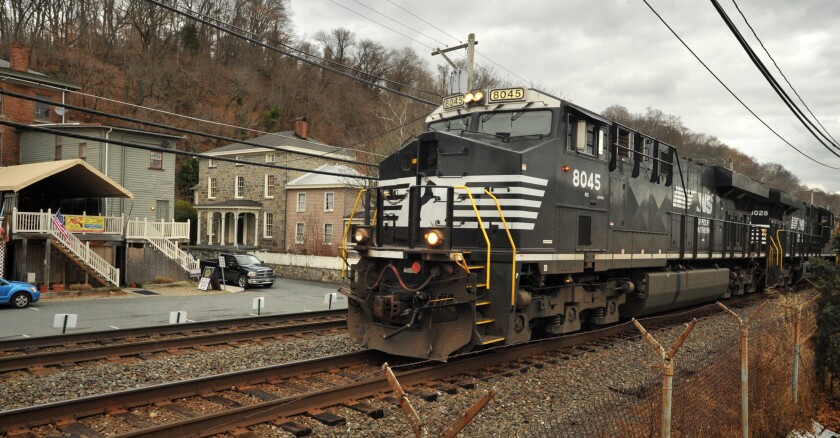
For Cincinnati residents, voting on the sale of a railway may seem like an insignificant issue compared to cannabis and abortion legalization, the other major issues on the ballot. However, the potential sale of the Cincinnati Southern Railway (CSR) has more serious implications than it may seem.
The City of Cincinnati is the only municipality in the country to own an interstate railroad. Since its completion in 1880, the railway has acted as a much needed link between the natural resources of the South and the Midwest. Due to the difficulty the city anticipated in running a railroad, in 1881, a lease was awarded to the Cincinnati, New Orleans and Texas Pacific (CNO&TP) Railway. As a result of a merger, the railway is now under the control of Norfolk Southern, who give the city of Cincinnati around $20 million a year for the lease.
In 2022, Norfolk Southern proposed a purchase agreement of $1.6 billion for the CSR, which the CSR Board of Trustees approved. Norfolk Southern and the Board came to a nonbinding agreement on the proposed sale terms in June of that year. The sale could supposedly more than double the city’s income from the railway, and could cover annual deficits of around $35 million from deferred and unfunded infrastructure maintenance projects. Cincinnati Mayor Aftab Pureval claims the annual returns could even total $60 million.
While the sale seems to make sense for both Norfolk Southern and the City of Cincinnati, there is something else to consider, which is likely the reason why the name Norfolk Southern seems so familiar to Ohioans: the East Palestine train derailment.
On February 3, 2023, a Norfolk Southern freight train carrying hazardous material derailed near East Palestine, Ohio. Of the 20 cars in the train containing hazardous material, 11 derailed. Five of the cars contained an estimated 115,000 gallons of vinyl chloride, a human carcinogen linked to liver cancer, brain and lung cancers, lymphoma and leukemia. To avoid an explosion, officials conducted a controlled burn of the chemicals, releasing substances such as phosgene, which is so toxic it was used as a chemical warfare agent during World War I.
In the aftermath of this catastrophe, the Ohio Department of Natural Resources estimates that 43,000 fish died in rivers and waterways. Moreover, Norfolk Southern estimates the costs associated with the clean up and related lawsuits to be up to $803 million.
The National Transportation Safety Board identified the cause of the derailment as an overheated bearing on one of the rail cars. While a sensor did trigger an alarm about the bearing, there was not enough time for the crew to stop the train. Norfolk Southern has received criticism about these sensors, as often only one employee, who sometimes works from home, monitors all roughly 1,200 detectors on the 19,500 miles of track in the Eastern United States. The company has also been scrutinized for using a business approach called Precision Scheduled Railroading (PSR). The goal of this approach is to transport the same amount of freight with fewer rail cars and fewer employees, leading to inevitable mass layoffs; Norfolk Southern has cut more than 9,600 jobs since 2002.
This reduction in staff has led to safety concerns, with rail companies expecting fewer employees to conduct inspections on longer trains in half the time. While labor unions have warned against the dangers of PSR for years, they have been overshadowed by the enormous profits it has delivered to investors.
One of the reasons why companies like Norfolk Southern can get away with cost-cutting measures like this is due to consolidation within the rail industry; including Norfolk Southern, there are seven Class One (carriers earning revenue greater than $1.032 billion) railroad companies in the U.S., which is down from 33 in 1980. With less competition and more power, rail companies have successfully overturned laws regulating certain safety protocols. In 2018, the Trump Administration rolled back Obama-era regulations for oil trains, which required more responsive electronic pneumatic braking (ECP) systems for railroads carrying crude oil or other flammable liquids.
The reversal of this law came after heavy lobbying from the rail industry, including Norfolk Southern, who opposed the high cost of installing ECP breaks and questioned their effectiveness. In contrast to this claim, Steven Ditmeyer, a former senior official at the Federal Railroad Administration, claimed that ECP breaks would have reduced the severity of the 2023 East Palestine derailment.
Norfolk Southern has routinely demonstrated, in this instance and others, that it prioritizes profit over the safety of both civilians and its own workers. So while it is difficult to predict what will happen if the Cincinnati Southern Railway is sold to Norfolk Southern, some East Palestine residents, such as Jami Wallace, have warned against it. After seeing how Norfolk Southern’s remiss practices devastated her own community, Wallace has warned Cincinnati residents not to give up control of the CSR to them.
The kind of negligence that worsened the East Palestine derailment will only continue if the CSR is sold to Norfolk Southern. Once this consolidation is achieved, any precedent of public ownership of our nation’s railways will be gone––making it infinitely more difficult to ever nationalize the industry.
The idea of public ownership of the railways has been supported by several groups, such as the United Electrical Workers (UE), who claim that private owners of the railways have “shown themselves utterly incapable of facing the challenge of the climate crisis, dealing fairly with their own workers, or even meeting the most basic needs of their customers.”
The sale of the Cincinnati Southern Railway may seem like a promising financial investment, but residents must ask themselves whether they can trust a company like Norfolk Southern to properly manage one of Cincinnati’s most lucrative assets. To ensure Norfolk Southern does not have complete power to impose its negligent practices onto the CSR, it is imperative that Cincinnati residents VOTE NO on Issue 22.
 miamipoliticalreview.org
Leave a comment