
Meredith Perkins
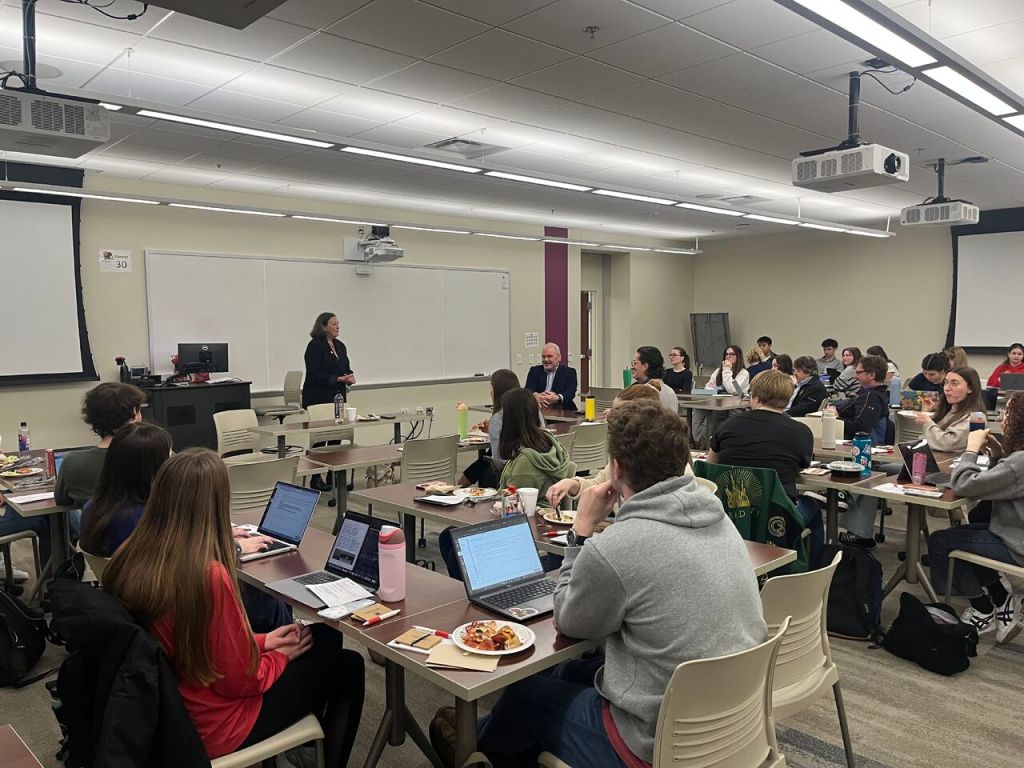
Justice Jennifer Brenner ‘78 is a pioneering figure in the Ohio legal community. She was Ohio’s first female Secretary of State (2007-2011), Ohio’s first John F. Kennedy Profile in Courage Award winner (2008), and the founder of Franklin County’s first adult felony drug court. In a visit to Miami University on March 10, she met with students interested in government and law careers to reflect on her career journey and offer thoughtful commentary about Ohio’s justice system. In her speech, she primarily focused on the role of a judge, the positive impact of drug courts, and issues of bias in the courtroom.
“Fair, humble, and organized.”
Justice Brenner is the only elected Democrat remaining in statewide office in Ohio following the November 2024 election. What keeps her in office may very well be her thoughtful perspective on the role of a judge in a community. When reflecting on how she carries herself as a judge, she told students she felt like every good judge should be “fair, humble, and organized.”
Brenner’s path to public service began in 1988, when she opened her own private law practice in Columbus. After focusing her private practice on issues of election law, she served as an attorney in Sherrod Brown’s office when Brown served as Secretary of State. From serving on state and local governmental boards to offering legal assistance to USAID, Brenner’s wide-spanning career ultimately led her to state-wide service as both a Secretary of State and Ohio Supreme Court Justice. When asked what she hoped her career’s legacy would be, she offered a thoughtful comment about what it means to be a public servant.
“A lot of elected officials worry about their legacy,” Brenner acknowledged. However, Brenner disagreed that anyone should be preoccupied with their work’s legacy.
Instead, “public service is about the service itself,” she emphasized. “The legacy will take care of itself if you’re giving it your all in that pure form of public service.”
For Brenner, her motivation to become a judge stemmed from a “higher calling” and she always reminds herself that with each case she presides over, she is not just dealing with a legal issue—she is dealing with a “person’s wellbeing.”
Creating Franklin County’s drug court
Throughout her career, one of Brenner’s proudest accomplishments was creating Franklin County’s first-ever drug court. A drug court is a type of court that specializes in helping participants recover from substance abuse disorder with the goal of providing alternatives to mass incarceration. Rather than having local courts crowded with drug offenses, a specialized court docket program siphons off drug cases to help reduce the amount of low-level, non-violent drug offenders that are so often cycled in and out of courtrooms. According to the National Treatment Court Resource Center, participants who complete drug court programs “are significantly less likely to be arrested again” when compared to those who were sentenced in traditional courts. They also reduce drug use among former drug users, according to Stanford University.
Brenner led the advocacy movement to establish a drug court in Franklin County, hoping to help individuals find “bridges out of poverty.” Today, Franklin County’s drug court still stands as a program designed to help address the issue of addiction through alternatives to incarceration, and Brenner knows many former clients who have had long-term success post-drug court.
Addressing bias in the courtroom
Since the start of the current Trump administration, judges have been a target of bias accusations, as they create legal obstacles to the sweeping executive orders and firings Trump and Musk condone. The concerns about judicial independence and safety have resulted in a statement by the American Bar Association (ABA) condemning the president’s actions, which drew national attention.
When asked about how courtrooms attempt to counteract bias within judges, Brenner described the judicial college program that offers continuing education workshops for current judges. “Ohio judicial college frequently has sessions on testing their biases in their continuing legal education,” Brenner explained.
To Brenner, continual legal education is the most important resource to have to ensure judges are up-to-date on current case law and to minimize chances for bias in the courtroom.
Ultimately, what Brenner’s lecture reminds us as Miami students is that we should listen to our call to public service. Brenner’s work offers an example of a service-minded public official who addresses community needs and focuses on making local impact.
 miamipoliticalreview.org
Leave a comment