
Pexels
Annabel DeChant
As we’re approaching the 2024 presidential election, voter turnout will be key, and one of the most interesting voter blocs that we can look at is the youth vote. To gain some insight into what the youth vote might look like in 2024, one can look at a variety of predictions, both for turnout numbers and for potential directions.
Context
First, to give context for the youth vote, let’s look at past turnout numbers, specifically for midterm and presidential elections. Alexandria Symonds, in a New York Times article, stated, “Fewer than half of Americans 18 to 29 voted in the 2016 presidential election — a gap of more than 15 points compared with the overall turnout.” This exemplifies the issue of low youth turnout, and the resulting underrepresentation of young voters. Although the turnout of youth was low relative to the population as a whole, recent years have shown encouraging numbers for youth voter turnout, with notable increases. The Center for Information and Research on Civic Learning and Engagement at Tufts University estimates, “50% of young people, ages 18-29, voted in the 2020 presidential election, a remarkable 11-point increase from 2016 (39%) and likely one of the highest rates of youth electoral participation since the voting age was lowered to 18.” This shows a significant increase in youth voter turnout for a presidential election. CIRCLE estimated that the youth turnout rate was 28.2% in 2018, compared to 2014, when they estimated the turnout at 13%. If there are more increases in youth turnout, they can become a powerful, perhaps underestimated, electorate. Increases seen are encouraging and show the potential of young voters.
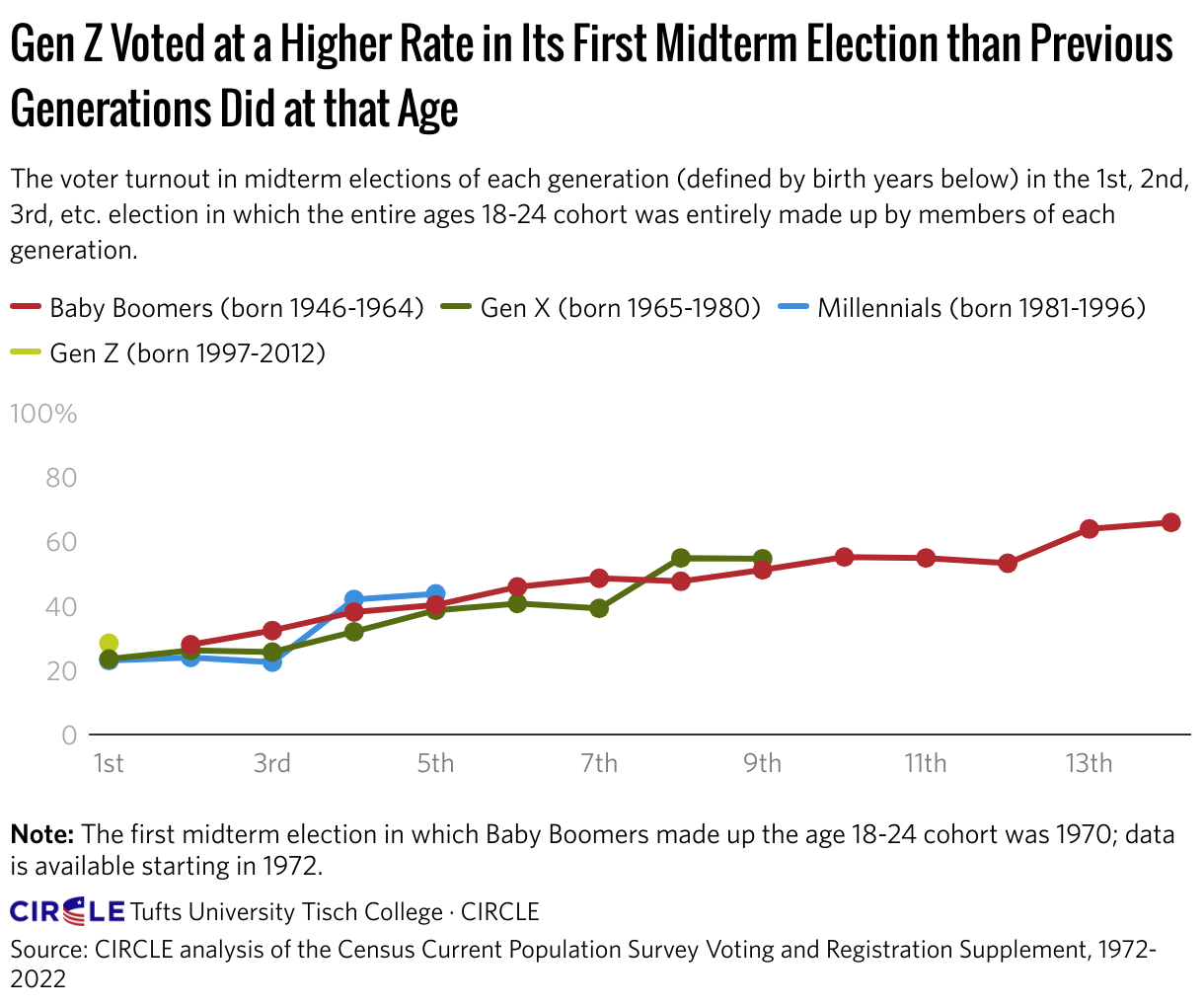
For a more recent point of context, we can look at the 2022 midterm elections. Following the 2022 elections, there have been some numbers showing what the youth voter turnout across the nation looked like. CIRCLE’s “day-after” estimate was that the youth voter turnout was 27%. They note that this makes a historic turnout rate: “This 2022 youth turnout is likely the second-highest youth turnout rate for a midterm election in the past 30 years, behind only the historic 31% turnout in 2018.” They also explain the impact of youth turnout in some particular places, pointing to the Pennsylvania and Georgia Senate races and the Wisconsin gubernatorial race. A Brookings Institute article says the youth vote was an important factor in the elections, pointing to several factors making Gen-Z an important electorate for the Democratic Party. Gianna Menill in The Hill cites an exit poll by the Edison Research National Election Pool that showed 63% going Democratic and 35% going Republican. A significant aspect of this outcome is how it breaks from previous patterns. CIRCLE says, “Based on Census data, Gen Z’s voter turnout in 2022 was higher than that of Gen Xers and Millennials when they made up the age 18-24 voting bloc.” These numbers after the election show relatively strong turnout by young voters, and the significance that comes with strong turnout. While still not a complete turnout, numbers for the 2022 elections are encouraging and show that youth can be motivated to turn out and be represented in elections.
Encouraging the Youth Vote
It’s also helpful to look at the efforts to promote youth voting. Here at Miami, the civic engagement team at the Wilks Institute for Leadership & Service works to empower Miami’s voter turnout in elections in a nonpartisan way. For one example, they worked on some great efforts for the 2022 general election. Valeri Hernandez-Godinez, one of the fellows at the Wilks Institute, said their team worked on voter registration and Get-Out-the-Vote initiatives, as well as various events relating to civic engagement. She said that each of the fellows had a day where they would engage in GOTV efforts through things like tabling at a variety of campus locations, including Armstrong Student Center, Farmer School of Business, the Seal on Academic Quad, and CSDI. Wilks also provided stamps and envelopes for requesting and sending absentee ballots, and helped to answer various questions that students had when planning their voting method. She spoke to the importance of youth voting in order to make decisions about their future world, as well as “exercising our right to vote and making our voices heard.” Looking back on the 2022 elections, she described that it was great to see “so many people, especially on [the] Miami campus, being so passionate about voting and promoting democracy.” She also said that she believed that youth did well with turnout and that youth turnout will “continue to increase.” Additionally, she described her work as a civic engagement fellow as “rewarding.” For future directions for her work, she hopes to work on strengthening civic education in the community, making sure people know “the importance of voting,” and having outreach to lots of communities at Miami.
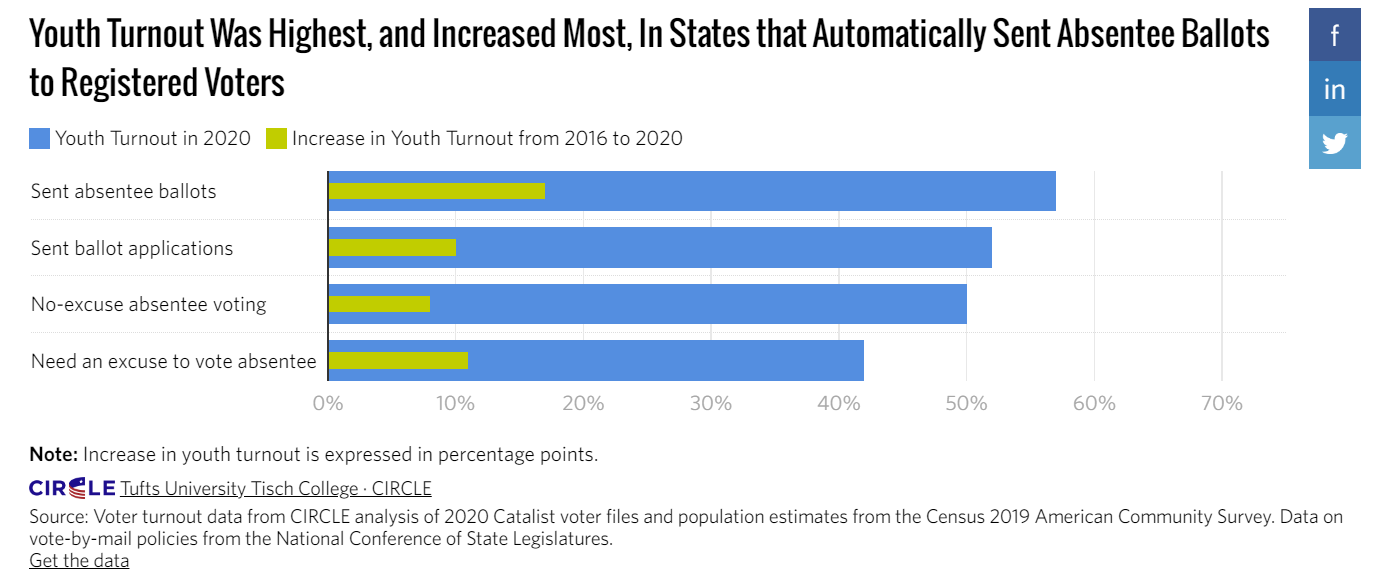
Various processes for voting have impacts on young voters. CIRCLE looked at how the availability of absentee voting affected the turnout and increases in youth voting in 2020, shown in the graph below.
Looking to 2024
CIRCLE once again provides a range of data points for the election, including likelihood to vote and political leaning. Among respondents between 18 and 34, 57% described themselves as “extremely likely” and 15% as “fairly likely” to vote in 2024. They state, “Among youth who say they’re extremely likely to vote, 51% prefer a Democratic candidate in 2024, 30% a Republican, and 16% are undecided.” While these numbers show the impact of a strong youth voter turnout, it’s also important to note that likelihood to vote isn’t uniform among the group. CIRCLE says, “Our data also identifies three groups that, as of now, are least likely to say they will vote in 2024: Black youth (44% extremely likely), nonwhite youth in rural communities (48%), and youth without college experience (41%),” noting historic inequities present as well as the ability of support to help address the issues. Additionally, 46th Edition of the Harvard Youth Poll found that, “Relative to this point in the 2020 presidential election cycle, the number of young Americans between 18- and- 29 years old who ‘definitely’ plan on voting for president has decreased from 57% to 49%,” indicating the numbers could drop off slightly as compared to recent jumps.
Key Issues
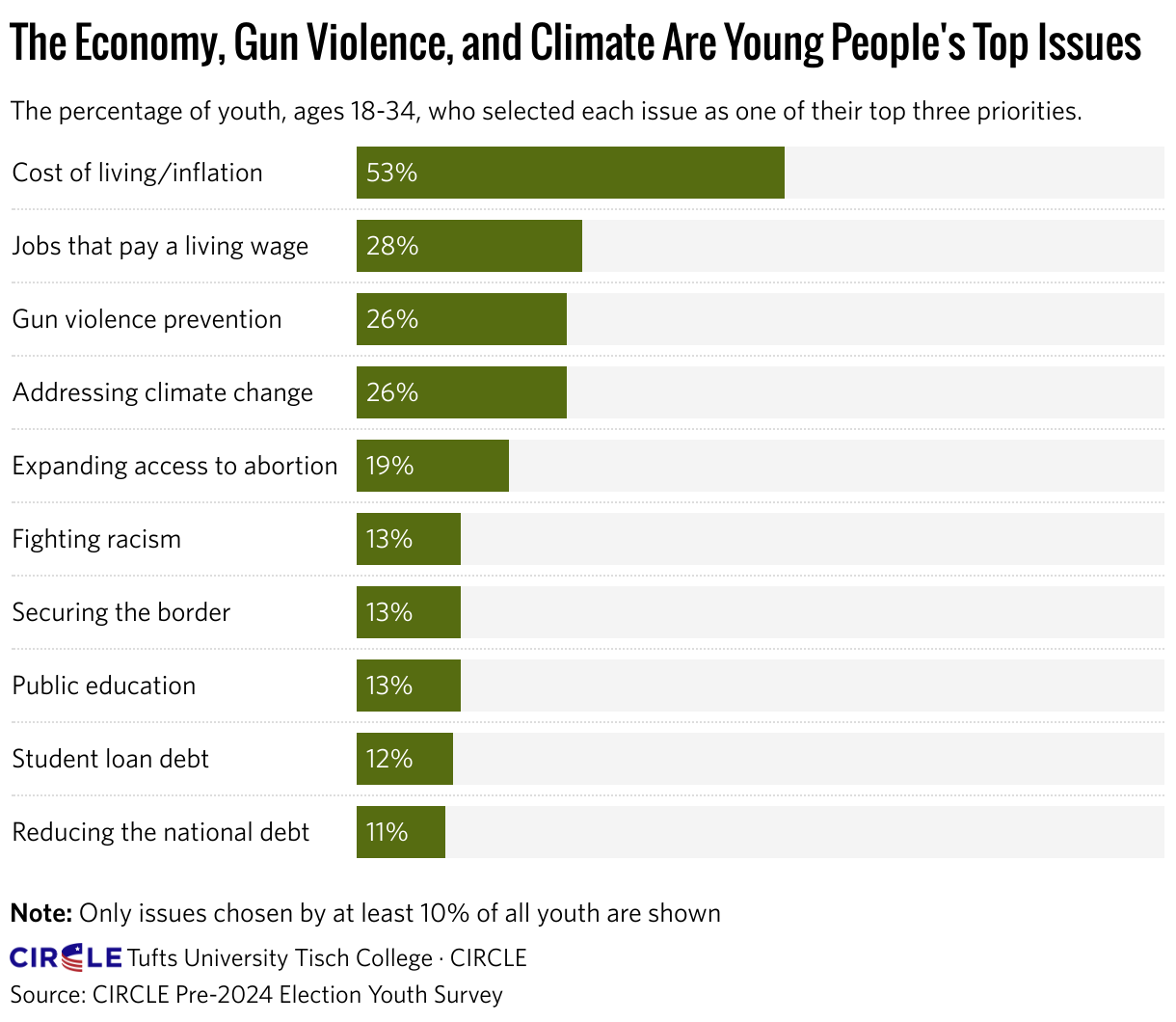
It’s also helpful to note the issues that will be key for young voters in 2024. In selecting their top issues, 53% included the cost of living and inflation, 28% included jobs with living wages, and 26% included dealing with climate change and preventing gun violence each, according to CIRCLE. Interestingly, climate change is one important predictor for likelihood to vote. CIRCLE states, “Seventy-two percent of young people who chose addressing climate change among their top three issues said they’re extremely likely to vote in 2024—slightly higher than for other major issues like abortion (70%), gun violence (64%).” Additionally, CIRCLE found that respondents’ emphasis on climate change was related to their party affiliation: “Among youth who prioritize climate change, 65% said they would vote for the Democrat if the election were held today—and only 5% for the Republican candidate.” Only 28% of those who didn’t select it indicated voting for the Democrat.
Impact of the Youth Vote
CIRCLE’s Youth Electoral Significance Index examines factors such as the voter registration rate and the youth vote differential, as well as the competitiveness of races in particular regions, to make predictions for the impact of young voters. The ten states for which the youth vote is expected to have the largest impacts in the 2024 presidential race are Wisconsin, Georgia, Arizona, Pennsylvania, Michigan, Nevada, North Carolina, Minnesota, New Hampshire, and Florida. Ohio is ranked second for the impact of the youth vote in the Senate race, and CIRCLE states, “Young voters can have a huge impact in a highly competitive Ohio Senate race if campaigns and communities help youth overcome barriers like low median income and a high juvenile detention rate.” They also note that Ohio has a strong youth voter registration rate currently, though recent elections have dropped. The recently-implemented voter ID law in Ohio is another consequential factor.
Importance of Voting
Regardless of political leanings, voting is an important way for young people to get engaged in our political processes. The importance of voting in elections is one area where Americans have a decent amount of agreement. The Pew Research Center found that almost 70% of adults in the US “say it’s very important to vote in elections to be a good member of society.” The bipartisan agreement on this is also encouraging, with similar numbers of Democrats and Democratic-leaning independents and of Republicans and Republican-leaning independents saying it’s important — 73% and 70%, respectively. It’s not only important for presidential or congressional elections. Young voters can also make their voices heard in their own communities. The League of Women Voters has worked to educate people on the importance of local voting, ranging from mayor to school board.
The Big Picture
Young voters can be influential when they engage, and there are a number of interesting trends in youth voting, from turnout in recent elections to the motivating issues. Looking towards 2024, we can see some key issues and several predictions for youth voter turnout. It’s encouraging to see ways that youth voting can be encouraged. However, perhaps the biggest thing that can be done to promote the youth vote is for each of us to prioritize and participate in this crucial means of democratic engagement. To get more information about doing so by making your voice heard at the ballot box, students and citizens can find resources for voting through organizations like vote.org, their Secretary of State websites, or the Wilks Institute right here at Miami.

 miamipoliticalreview.org
Leave a comment